
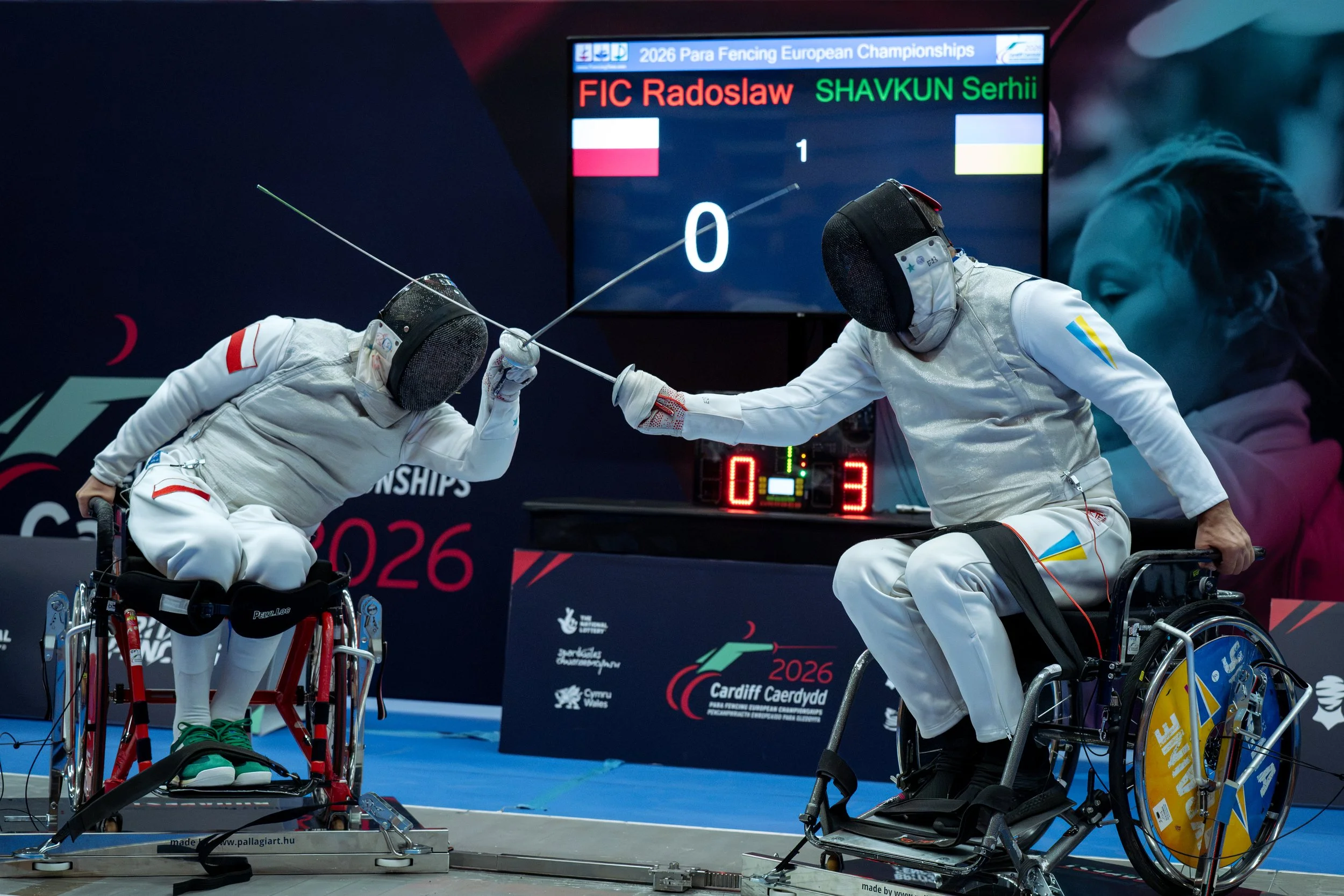
EUROPEAN PARA FENCING CHAMPIONSHIPS 2026
Louise Anderbjörk
On 11 October, the Sport Wales National Centre in Cardiff hosted the penultimate day of the Cardiff 2026 Para Fencing European Championships; a six-day event that brought 132 athletes from 15 countries to the Welsh capital. Organised by British Fencing in partnership with UK Sport, it was the first European Championships in the discipline held in Britain since Sheffield in 2011 and, this time round, marked the first ranking competition in the qualification window for the LA 2028 Paralympic Games. A gold here in Cardiff therefore carried double the weight, with a European Title and a direct ticket to LA 2028.
In para fencing, as one of the oldest Paralympic sports in history dating back to the 1950s, international events are split into the same three disciplines as standing fencing: Foil, Épée and Sabre. These names represent the distinct weapons used and the disciplines mainly differ in how points are scored. In Épée, the whole body is a valid target but a fencer can only score with the point of their weapon, and there is no right of way so both fencers can score at once. Foil on the other hand, while also being point-only to score, only allows the torso as a valid target and does include a right of way to decide who receives the point when both fencers hit together. This can, for example, be related to who initiated the attack. Finally, Sabre is known for its speed, allowing points to be scored both with the cut of the blade as well as the point, and with the valid target including everything above the fencers’ waists. Regardless of impairment, all para fencers compete in wheelchairs that are fixed to the piste in stationary frames, which means that all three weapons rely heavily on upper-body movement and reach, rather than footwork. This makes the sport very engaging to watch, and showcased some incredible athleticism across the championships in Cardiff.
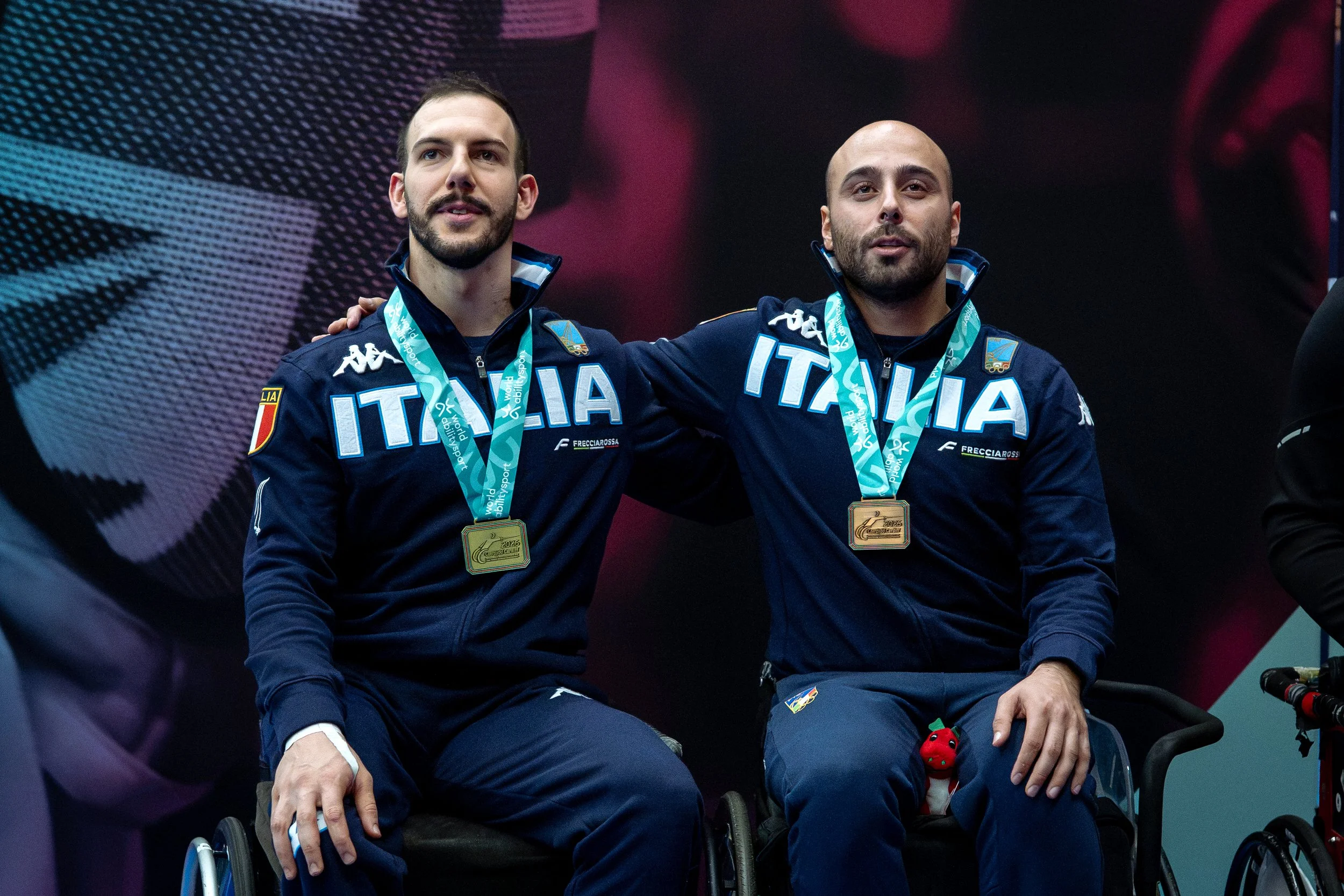
Photo: Louise Anderbjörk
On the Saturday, competition began at 9am with qualification rounds in men’s foil and women’s sabre. The sports hall was filled to the max with action with over fifteen bouts running at once and teams of fencers, coaches, and supporters from across Europe surrounding every piste. By midday, the early classes that had started with up to 31 entrants had now whittled down to the final four semi-finalists across men’s foil A and C and women’s sabre B.
As the semi-finals then gave way to the first set of finals, it quickly became clear that this morning would belong to Italy. In the first title match of the day, in men’s foil C, Leonardo Rigo beat Ukraine’s Serhii Shavkun with a striking 15-8, and this was soon to be followed by Emanuele Lambertini edging Hungary’s Richard Osvath 15-14 in men’s foil A. With two titles won, Italy saw one more to go and in women’s sabre B, Andrea Ionela Mogos took early control of the final against Georgia’s Irma Khetsuriani to hold on and finish as the third Italian European Champion of the morning with 15-14.
Up until this point of the day, no British fencers had been able to make it into the final four in contention for a medal. However, after lunch, as the men’s foil B class neared its closing stages, Great Britain’s Dimitri Coutya set out to change that. In the world of Para Fencing, Coutya stands out as one of the most decorated and versatile athletes in modern history. He holds two paralympic golds from Paris 2024, 10 World Championships Medals, and 11 European Championships titles. He is one of the very few fencers in the world to have competed in all three weapons at the Paralympics, and he is now heading into this European semi-final in foil B backed by his recent historic triple gold at the Budapest 2026 World Cup as well as his two new European titles won earlier this week in Cardiff.
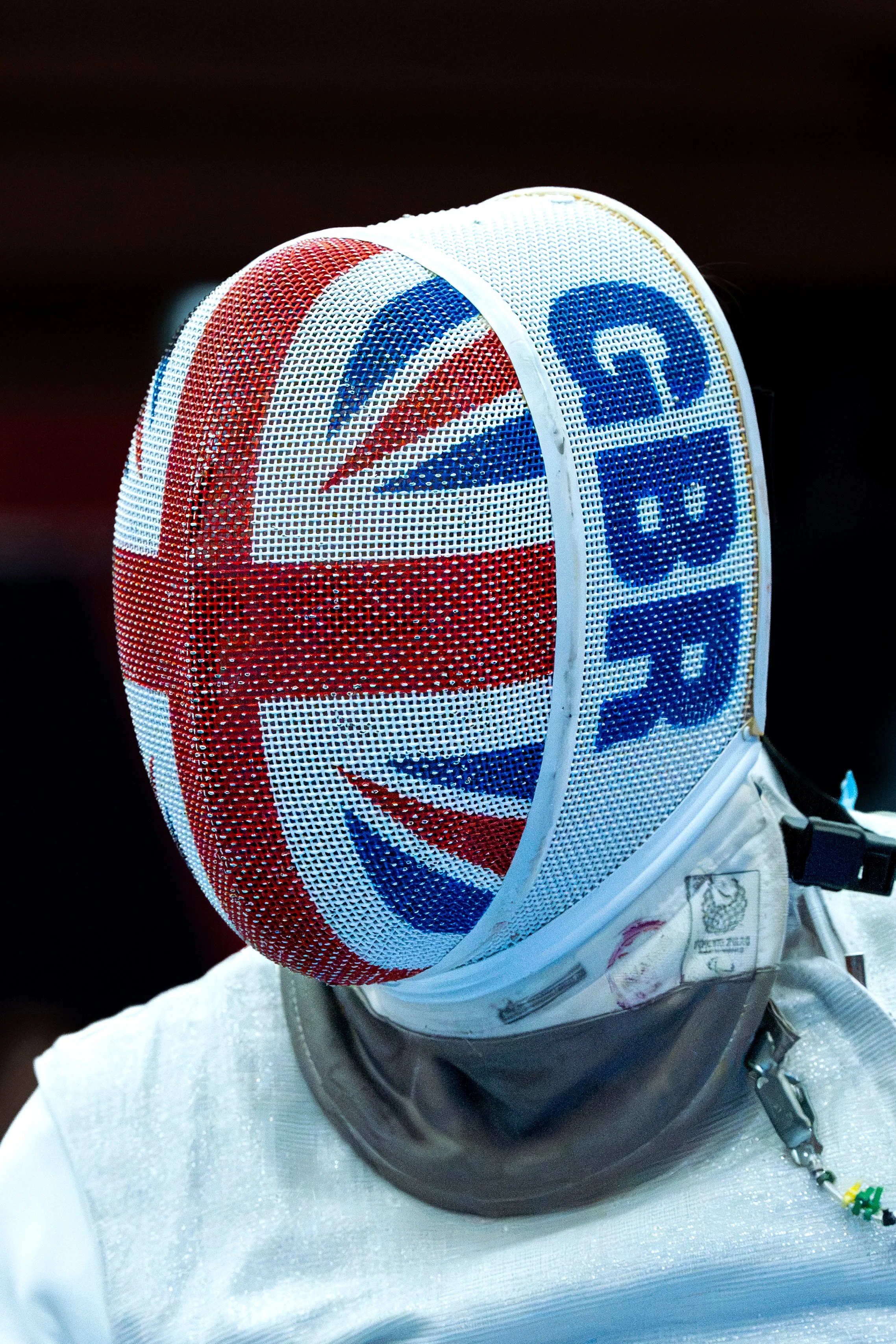
Photo: Louise Anderbjörk
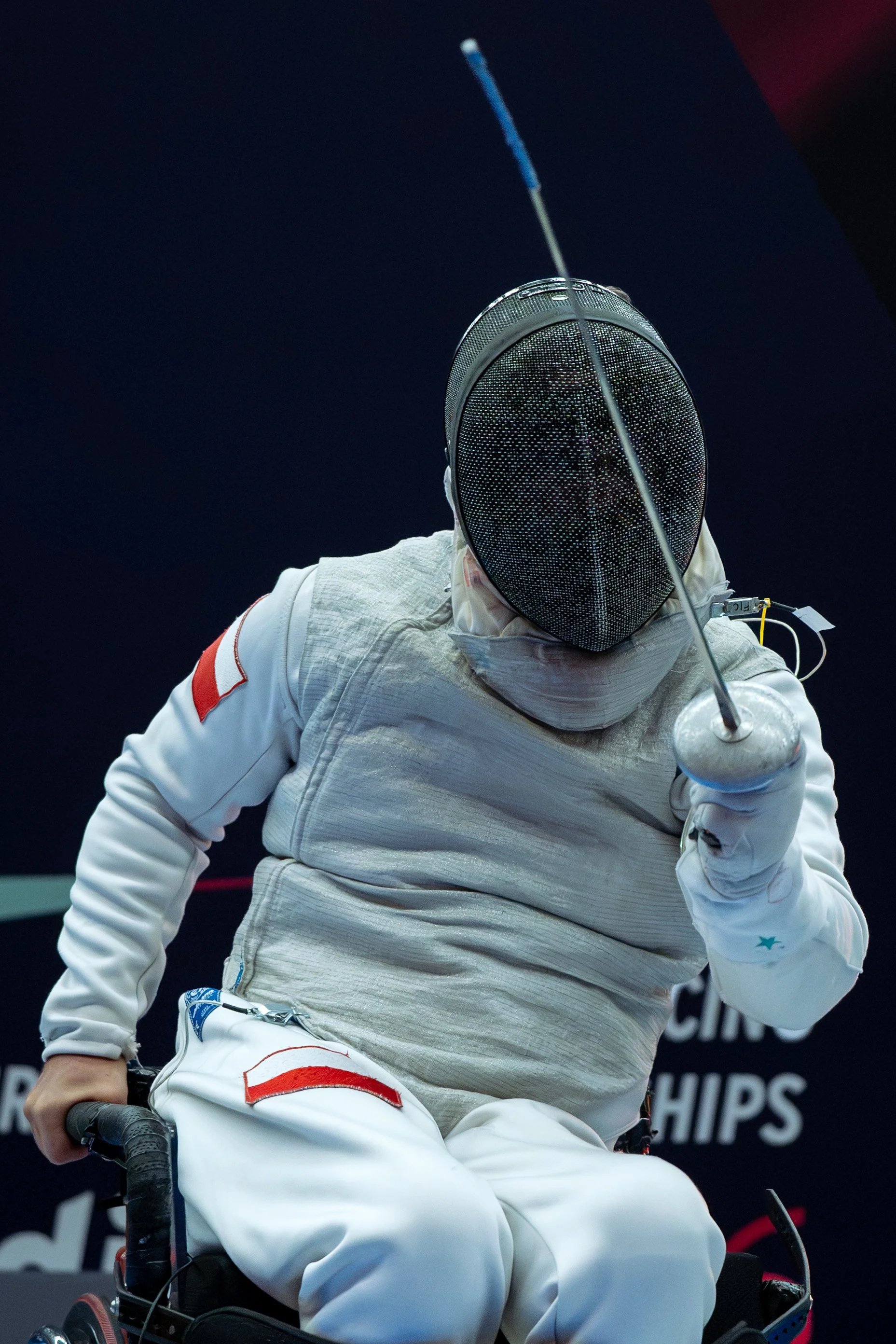
Photo: Louise Anderbjörk
For the semi-finals, his opponent was Ukraine’s Oleg Naumenko, who started strong and led 7-1 for some time, but with the technique and precision he is so well known for, Coutya steadily narrowed the gap in the second half of the bout to win 15-12. Now, two gold medal matches were all that remained of the day: Dimitri Coutya against Italy’s Michele Massa in men’s foil B, and Poland’s Kinga Drozdz against Hungary’s Andrea Eva Hajmasi in women’s sabre A.
The women’s bout was the first to take place, where Kinga Drozdz got off to a flying start that ended up taking her all the way to a European gold and a qualifying place for LA 2028. The men’s foil B title bout that followed was more back-and-forth. Coutya established an early lead that Massa rapidly closed, but Coutya kept his composure, scored the remaining touches, and won 15-9 to become European Champion. This made him the first Briton ever to win gold in all three weapons at a single Para Fencing European Championships and thereby marked a historic qualification for LA2028.
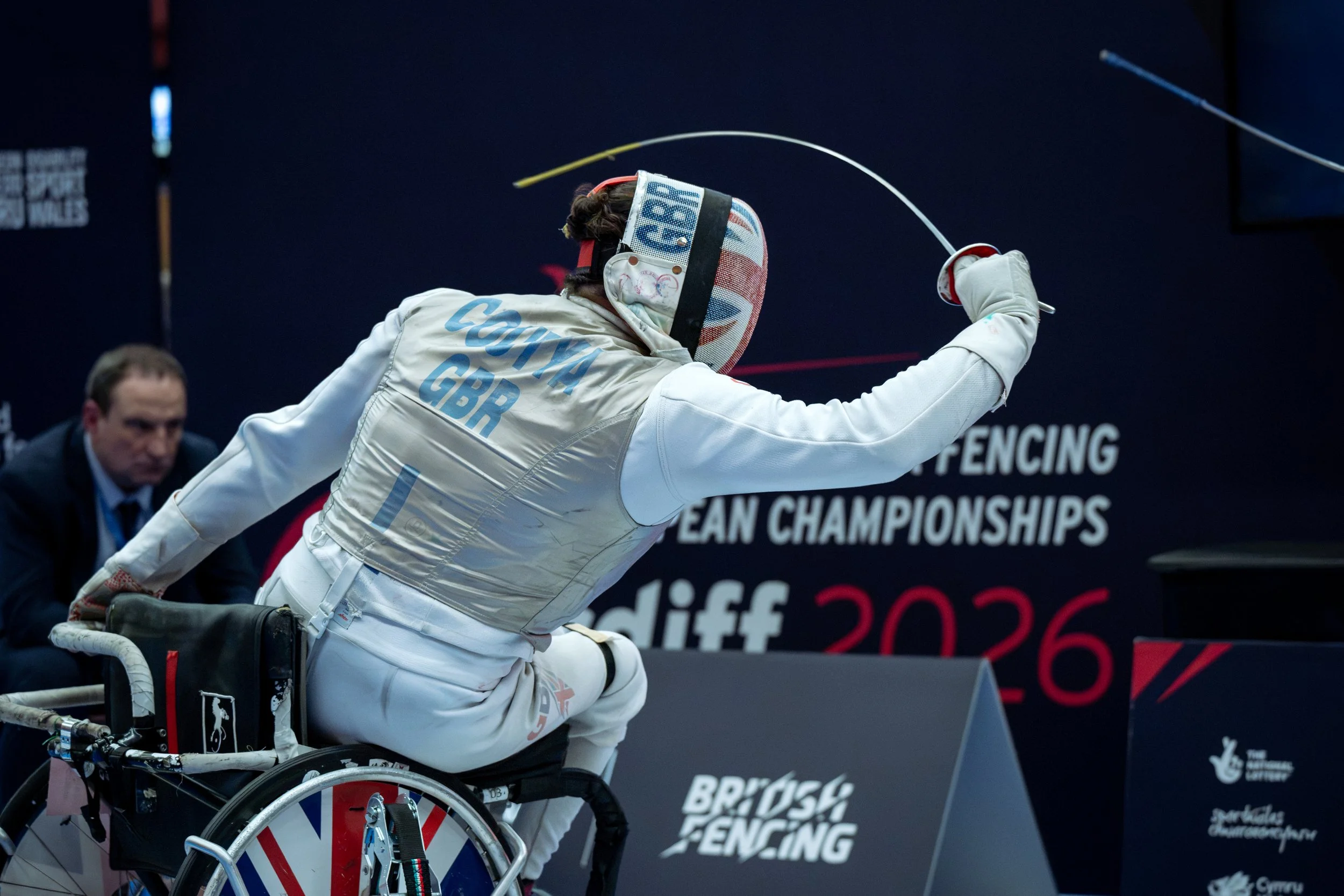
Photo: Louise Anderbjörk
Speaking to British Fencing after receiving his medal, Coutya said: “I really didn’t know what to expect coming here. I’m really happy to have come away with these results, but again, it’s a testament to the work that the team around me, and my friends and family, have put in to help get me into the shape I’m in today.”
At the end of the week, 23 European titles had been won and Great Britain’s 14-strong squad successfully claimed seven medals. With over twelve countries winning at least one medal, it’s been an incredible European Championships and gathering of the sport, and an exciting start to the Paralympic qualifying journey as several nations leave Cardiff on their way to Los Angeles in two years time.
This article is part of the PRISMA Editorial Series ‘Reframing the Game’